Bail Basics
The One Idea That Drives All Bail
Liberty Before Conviction Is A Constitutional Principle
At the heart of every bail application — anticipatory, regular, or interim — lies the presumption of innocence. Bail exists to ensure that an accused person is not punished through unnecessary imprisonment before guilt has been legally established. Courts balance individual liberty with the interests of justice while deciding whether custody is truly necessary.
01
What Bail Is
Bail is a conditional release from custody — or protection from arrest — granted by a court while criminal proceedings continue.
It does not mean acquittal or innocence. It simply allows the accused to remain free while cooperating with the judicial process and appearing before the court when required.
02
Why Bail Exists
Indian criminal law recognizes that undertrial prisoners should not suffer punishment before conviction merely because proceedings are ongoing.
Courts therefore examine whether the accused is likely to flee, tamper with evidence, threaten witnesses, or repeat the alleged offence before deciding whether continued custody is necessary.
Bail Is The Rule, Jail Is The Exception
The Supreme Court of India has repeatedly emphasized that liberty is a constitutional value. Unless custody is genuinely necessary for investigation, public safety, or trial integrity, courts generally lean toward granting bail — particularly where the accused is cooperating with the process and poses no substantial risk.
Pre-Arrest Protection
Legal Protection Before Custody Begins
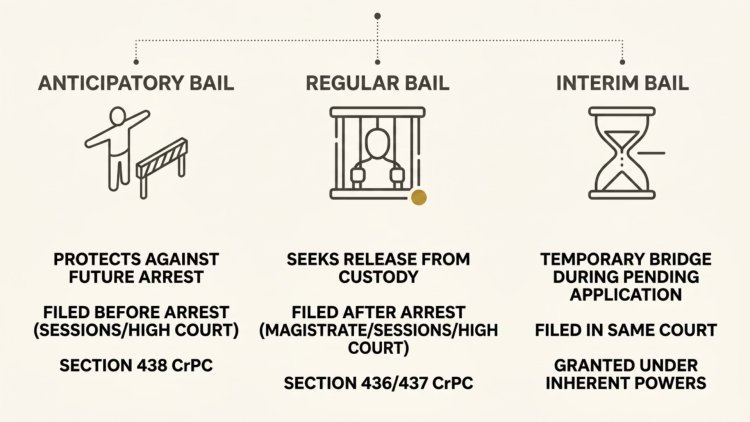
Anticipatory bail is a pre-arrest legal safeguard available to a person who reasonably believes they may be arrested for a non-bailable offence. If granted by the court, it ensures that the individual will be released on bail immediately if an arrest is later made in connection with that accusation.
01
Legal Basis
Anticipatory bail is governed by Section 438 of the CrPC and Section 482 of the BNSS. Although the word “anticipatory” does not appear in the statute itself, the concept was introduced through the Law Commission's 41st Report and is now firmly recognized in Indian jurisprudence.
02
Who Can Apply
Any person who reasonably apprehends arrest for a non-bailable offence may seek anticipatory bail. An FIR is not mandatory before filing — credible apprehension based on surrounding circumstances is sufficient to invoke the court's protection.
03
Courts With Jurisdiction
Only the Sessions Court and the High Court have authority to grant anticipatory bail. Magistrates cannot grant this relief. If relief is denied by the Sessions Court, the applicant may approach the High Court and ultimately the Supreme Court under Article 136.
04
Factors Courts Consider
Courts assess the seriousness of the accusation, the applicant's criminal history, the likelihood of absconding, and whether the complaint appears malicious or intended to harass. Conditions may also be imposed to ensure cooperation with the investigation.
Protection Activates The Moment Arrest Happens
Once anticipatory bail is granted, the applicant cannot be kept in custody for the covered accusation. If the police later arrest the individual, they must be released on bail immediately subject to the court's conditions. Depending on the order, the protection may last for a fixed duration or continue until the completion of trial.
Bail & Criminal Procedure
If You're Already in Custody: Regular Bail
Bail After Arrest Protects Liberty During Trial
Regular bail applies after a person has already been arrested and placed in police or judicial custody. Its purpose is to ensure that an accused person is not unnecessarily imprisoned before guilt is proven, while still ensuring their availability during investigation and trial proceedings.
01
Legal Provisions
Regular bail is governed by Sections 436 and 437 of the CrPC (Sections 478 and 480 under BNSS).
Section 436 applies to bailable offences where bail is a legal right, while Section 437 governs non-bailable offences where courts exercise judicial discretion.
02
Bailable vs. Non-Bailable Offences
In bailable offences, the accused has an absolute right to bail and the police or court must release them upon compliance with procedural requirements.
In non-bailable offences, courts examine factors such as the seriousness of the allegations, risk of flight, and possibility of tampering with evidence before granting relief.
03
Which Court Hears the Application
Bail applications are usually first moved before the Magistrate after arrest, especially for offences triable by that court.
Sessions Courts and High Courts possess wider powers under Section 439 CrPC, while the Supreme Court may intervene under Article 136 as a final constitutional remedy.
04
Default / Statutory Bail
Under Section 167(2) CrPC, the accused gains an indefeasible right to bail if the police fail to file a chargesheet within the prescribed statutory period.
The investigation deadline is generally 60 or 90 days depending on the seriousness of the offence, making statutory bail a powerful safeguard against indefinite detention.
Bail & Criminal Procedure
The "Gap-Filler": Interim Bail
Temporary Protection While the Main Bail Plea Is Pending
Interim bail acts as a short-term bridge between custody and the final hearing of a regular or anticipatory bail application. It exists to prevent unnecessary detention during procedural delays and ensures that liberty is not sacrificed simply because the court has not yet heard the primary bail matter.
01
Why It Becomes Necessary
Indian courts often face heavy case backlogs, meaning bail hearings may not happen immediately after filing.
Interim bail prevents an accused person from remaining in custody solely because the court has not yet heard the main application.
02
Duration and Scope
Interim bail is temporary and usually remains valid only until the next hearing date of the primary bail application.
It does not decide the final merits of the case — the court reserves that determination for the complete hearing on regular or anticipatory bail.
03
Legal Standing
Interim bail may be granted by the Sessions Court or High Court while the substantive bail application remains pending.
Courts exercise inherent powers under Section 482 CrPC (Section 528 BNSS) to grant temporary relief and protect liberty during ongoing proceedings.
Bail Process Simplified
Quick Side-by-Side: When Each Type Applies
Understanding which bail to seek becomes straightforward once you identify the stage of the criminal proceeding you are in. The three types of bail cover every possible scenario — before arrest, after arrest, and during the wait for a bail decision.
1
Stage 1: Apprehension of Arrest
You fear arrest but have not yet been taken into custody.
Seek Anticipatory Bail under Section 438 CrPC from the Sessions Court or High Court. If granted, you will be released immediately upon arrest.
2
Stage 2: Already Arrested
You have been arrested and are currently in custody.
Seek Regular Bail under Sections 436 or 437 CrPC. The appropriate court depends on the seriousness and stage of the case.
3
Stage 3: Waiting for Hearing
Your bail application is pending but the hearing date is still far away.
Seek Interim Bail to bridge the gap until the court hears and decides your primary bail application.
Bail Conditions & Compliance
Typical Court Conditions Attached to Bail
Bail Protects Liberty — But It Comes With Legal Obligations
Bail is never unconditional. Regardless of the type of bail granted — anticipatory, regular, or interim — courts routinely impose conditions to ensure cooperation with the investigation, protection of evidence, and continued appearance before judicial authorities. Violating these conditions can result in cancellation of bail and immediate re-arrest.
Appear on Specified Dates
The accused must appear before the investigating officer or the court whenever directed. Failure to attend hearings or investigation proceedings may lead to cancellation of bail and issuance of a non-bailable warrant.
No Tampering With Evidence
Courts strictly prohibit the accused from destroying evidence, influencing witnesses, threatening victims, or interfering with the investigation in any manner. Any attempt to obstruct justice can revoke bail protection immediately.
Travel Restrictions & Passport Surrender
In serious matters, courts may restrict travel outside the jurisdiction or direct surrender of the passport to prevent the accused from fleeing or avoiding trial proceedings.
Surety and Personal Bond
Courts usually require execution of a personal bond and one or more sureties who guarantee the accused's future appearance. The amount depends on the seriousness and circumstances of the offence.
Legal Principle: Under Section 440 CrPC, bond amounts must be fixed reasonably and cannot be excessive or oppressive. Courts cannot impose impossible conditions that effectively deny bail in practice.
Bail Framework Simplified
Takeaway: Choose the Bail by the Stage of Your Case
The entire bail framework in India can be distilled into one decisive question. Before filing any application, ask yourself: "Has the arrest happened yet?" Your answer determines which type of bail to seek, which court to approach, and which legal provisions apply.
Has Arrest Happened?
This is the decisive question that determines your bail strategy.
File under Section 438 CrPC before the Sessions Court or High Court for pre-arrest protection.
If Yes: Regular Bail
Apply under Sections 436 or 437 CrPC before the Magistrate, Sessions Court, or High Court.
Waiting for Hearing?
Seek Interim Bail to bridge the period until the main bail application is finally heard.
A Final Note on Bail Cancellation
Bail is not permanent. Under Section 439(2) CrPC, courts may cancel bail if the accused violates conditions, tampers with evidence, intimidates witnesses, or commits fresh offences. The prosecution or complainant may also seek cancellation if new facts emerge.
Key Statutes at a Glance
Section 436 CrPC: Bail in bailable offences
Section 437 CrPC: Bail in non-bailable offences
Section 438 CrPC: Anticipatory bail
Section 439 CrPC: Higher court bail powers
Section 167(2) CrPC: Default/statutory bail
BNSS, 2023: New criminal procedure framework
Remember: Bail is a fundamental aspect of personal liberty under Article 21 of the Constitution of India. Courts are dutybound to consider bail applications promptly and fairly. Always consult a qualified advocate for legal advice specific to your circumstances.